



ExtendedHorizons is a view distance extension plugin engineered specifically for modern Minecraft Paper & Folia servers. It streams distant terrain far beyond the server's native simulation and view distances by loading pre-generated chunks directly from disk or capturing chunks already active in memory.
Clients receive terrain snapshots without keeping distant chunks loaded for simulation. Reading, preparing and sending those snapshots still consumes CPU, memory and bandwidth.
Note
- Shared chunk reads & compression cache: Compressed packet data is cached and shared across players viewing identical terrain.
- Direction-aware delivery: Prioritizes chunks along the player's vector of travel, smoothly filling surrounding terrain when stationary.
- Native Anti-Xray integration: Custom block masking in distant chunks to protect ores without leaking underground data.
- Far-player tracking: Optional distant player rendering and synchronization beyond vanilla tracking ranges.
Measured on November 12, 2026, using Paper 26.3 build 175, 50 simulated Java clients, a 6 GiB maximum server heap and the same pregenerated world and flight route. Every run received 90 seconds of initial loading, followed by 35 seconds of flight. Paper alone uses a native view distance of 32; EH uses a native distance of 4 and extends visibility to 32. Simulation distance is 2 and Netty uses 4 threads throughout. EH uses a 256 MiB / 30-second cache and a 192 MiB/s uncompressed send budget.
| Metric | Paper only, native 32 | EH 32, flush consolidation off | EH 32, flush consolidation on |
|---|---|---|---|
| Runs | 2 | 1 | 2 |
| Terrain Coverage (end of flight) | 94.36–95.25% | 99.70% | 99.72–99.73% |
| Received Network Payload (flight) | 600–639 MiB | 1,107 MiB | 1,166–1,169 MiB |
| Mean Server CPU | 30.8–31.5% | 26.3% | 11.7–13.4% |
| Mean Used Java Heap (flight) | 3,537–3,604 MiB | 923 MiB | 831–867 MiB |
| Server Tick Duration (p95) | 61.9–83.6 ms | 17.9 ms | 15.8–22.0 ms |
| Local RTT (p95) | 894.2–928.0 ms | 395.4 ms | 8.5–9.6 ms |
| Median Time to 95% Coverage during arrival | 48.2–49.4 s | 36.1 s | 35.9–36.0 s |
| Median Flight Speed | 57.9–58.0 blocks/s | 58.7 blocks/s | 60.3–60.5 blocks/s |
| Position Corrections during flight | 0 | 0 | 0 |
Ranges show the minimum and maximum per-run results, including per-run p95 values; they are not confidence intervals or pooled percentiles. The two EH modes use the same JAR and settings, changing only consolidate-flushes. None of the runs in this table used a profiler or generated new terrain.
These tests used clustered players, with the server and clients sharing one Windows machine with an AMD Ryzen 7 5800H and 16 logical processors. CPU is the server process's share of total host CPU capacity, excluding the simulated clients. Traffic counts all clientbound application bytes, excluding TCP/IP headers. RTT uses protocol ping responses over localhost. Coverage counts received chunks within the same 32-chunk target, rather than rendering performance or FPS. Mean used heap includes temporary allocations and is not retained memory or process RSS. Mob spawning, weather changes and random ticks were disabled; far players, chunk updates and EH Anti-Xray were disabled for the main comparison.
The optimization uses Netty flush consolidation for both native packets and extended chunks on active EH TCP connections. It reduces transport overhead while preserving packet order and the existing encoding path. EH sent more application data than Paper alone in this comparison. These results do not establish a universal CPU, latency or bandwidth advantage, and distant snapshots do not provide the full behavior of native chunks.
A separate 50-client run enabled far players with a limit of 64 per viewer, equipment and actions, chunk updates, and EH Anti-Xray. It measured 11.8% server CPU, 8.2 ms RTT p95, 98.47% final flight coverage, and 1,597 MiB received payload. The bots flew without editing, combat or equipment-change load; functional checks were separate. Optional features can change delivery and bandwidth costs, so this result is separate from the main comparison.
- Java 25
- Paper (Tested across 1.21.11, 26.1.2, 26.2, and 26.3)
- MapacheeeLib (Required dependency, install alongside EH)
- WorldEdit or FastAsyncWorldEdit (FAWE) (Optional, for real-time terrain invalidation on bulk edits)
Folia dependency limitation: Streaming and packet integrity passed on Folia 26.3, but Winter Paper 3.0.0 throws UnsupportedOperationException during shutdown when cancelling Bukkit scheduler tasks. This also occurs with the previous EH build and requires a dependency fix for a clean shutdown.
Important
- Pregenerated world recommended: ExtendedHorizons serves available terrain; it does not generate new chunks on the fly to protect TPS.
- Client view distance: A player's in-game render distance setting caps what the client renders.
- Download the latest
ExtendedHorizons-<version>.jarand matchingMapacheeeLibfrom Releases. - Place both JAR files in your server's
plugins/directory. - Start the server to generate configuration files.
- Tweak
plugins/ExtendedHorizons/config.ymlto your liking and run/eh reload.
Warning
Upgrading from v3: Back up your previous configuration and generate a clean config.yml. The configuration schema has been redesigned for v4.
A snippet of key settings in config.yml:
| Setting | Default | Description |
|---|---|---|
view-distance |
32 |
Target view radius in chunks (includes native server distance). |
disabled-worlds |
[] |
List of world names where extended chunks are disabled. |
distance-permissions.enabled |
true |
Assigns target distances through extendedhorizons.max.<distance> permissions. |
distance-permissions.default-distance |
-1 |
Uses view-distance for players without a matching permission. An explicit value from 2 to 128 sets a separate fallback. |
distance-permissions.refresh-seconds |
5 |
Permission refresh interval when LuckPerms event integration is unavailable. |
player-mib-per-second |
8 |
Maximum uncompressed chunk packet bandwidth per player per second. |
global-mib-per-second |
192 |
Global server-wide bandwidth budget for chunk streaming. |
consolidate-flushes |
true |
Batches TCP flushes on active EH connections to reduce transport overhead. |
reuse-encoded-chunks |
true |
Reuses cached wire payloads for unchanged EH snapshots on supported native TCP pipelines. |
workers |
2 |
Background worker threads for chunk reading and processing. |
cache-mib |
256 |
Snapshot cache budget in MiB. The compressed packet cache has an additional budget of one quarter of this value. |
cache-seconds |
30 |
Maximum age of a cached snapshot. Enabled chunk updates invalidate edited snapshots before this expires. |
far-players.enabled |
true |
Renders distant players in fake chunks (with equipment and action support). |
chunk-updates.enabled |
true |
Dynamically updates fake chunks on block break, place, growth, and physics. |
chunk-updates.worldedit |
false |
Listens to WorldEdit / FAWE commits to update distant terrain after large edits. |
anti-xray.enabled |
false |
Obfuscates specified ores/blocks in extended chunks. |
anti-xray.hidden-blocks |
Ore list | List of block IDs to mask out in fake chunk packets. |
Tip
Anti-Xray Notice: If Paper's engine Anti-Xray is active for a world, ExtendedHorizons requires its own anti-xray.enabled: true with a configured block list to send extended chunks in that world.
Set distance-permissions.enabled: true to assign view distances through permissions. Players without a matching node use distance-permissions.default-distance. Its default, -1, follows the current view-distance, including changes applied with /eh reload; an explicit value from 2 through 128 overrides that fallback. Existing numeric values are preserved when upgrading, so change an existing 8 to -1 to adopt inheritance. The highest granted extendedhorizons.max.<distance> node wins, from 2 through 128. For example, extendedhorizons.max.16 grants a total target radius of 16 chunks, including native chunks. extendedhorizons.bypass uses the configured view-distance maximum. These nodes default to false, including for operators.
The configured maximum, client render distance, disabled worlds and Anti-Xray requirements still apply. Permissions control extended delivery and cannot reduce chunks sent by the server's native view distance. Setting the fallback or a permission to 2 disables additional delivery when the native distance is at least 2. The V3 node extendedhorizons.max.1 is accepted as an alias for 2.
With LuckPerms installed, EH refreshes on user-data recalculation, group changes and context-update events, coalescing notifications on the player's scheduler. It also refreshes on join, teleport, world changes and /eh reload. Without the event integration, distance-permissions.refresh-seconds controls periodic refresh (5 seconds by default). LuckPerms context events are best-effort hints; custom context calculators must signal updates correctly. Direct permission attachment changes outside LuckPerms may require /eh reload while the event integration is active. /eh stats reports which mode is in use. LuckPerms is optional and is not bundled.
For pregenerated terrain at a 32-chunk target, start with cache-mib: 256, cache-seconds: 30, workers: 2 and the default send limits. Existing configuration values are preserved when upgrading; change these settings explicitly and run /eh reload to adopt the new cache defaults. Keep your far-player, chunk-update, WorldEdit and Anti-Xray settings enabled as needed.
Set the server's native view distance below EH's target to offload distant terrain delivery; the benchmark uses 4 native chunks and a 32-chunk EH target. EH keeps native chunks under the server's control.
Leave consolidate-flushes: true to use the optimized transport path. Winter adds the key when it is missing during startup or /eh reload; an explicit false is preserved. EH installs its own handler while extended streaming is active on a TCP connection and removes it when that stream is disabled or detached. The existing server handlers remain in place. Setting this option to false restores EH's previous flush behavior without disabling its other features.
Keep reuse-encoded-chunks: true to avoid serializing and hashing the same immutable EH snapshot for each viewer when its compressed payload is still cached. Native chunk packets retain their normal encoding path. EH automatically falls back when the connection has an unrecognized encoder or interceptor in the affected pipeline. Set this option to false when comparing or troubleshooting the transport path. Winter fills the missing key on startup or /eh reload while preserving an explicit false.
The encodedHits counter in /eh stats counts uses of this path, including duplicate deliveries suppressed before encoding. These hits are included in compressionHits; they are not additional chunks or a coverage measurement.
For a faster initial load, test global-mib-per-second: 256 if CPU and network capacity permit. Earlier budget-only tests, before flush consolidation, reduced median arrival time to 95% coverage from 36.3–36.7 seconds to 28.6 seconds with 50 clients spread across the world. Recheck coverage, RTT and outbound traffic on your host when increasing this budget.
Use the counter changes in /eh stats over a fixed interval to guide tuning:
- If
diskReadsandloadedCaptureskeep increasing rapidly while players revisit the same terrain, increasecache-mibif heap capacity permits. Increasing the TTL helps reuse snapshots that would otherwise expire; live edits require chunk updates to be enabled. - If source preparation is keeping up but delivery is repeatedly
throttled, the send budget may be limiting initial loading. Increasingglobal-mib-per-secondcan trade more CPU and network activity for faster delivery. Both bandwidth settings count uncompressed packet bytes, so monitor actual outbound traffic as well. - Increase
workersonly when cache misses keep source preparation busy and the machine has spare CPU. Additional workers do not increase the send budget or remove the cost of native player tracking. - If the network event loop is backed up, increasing the send budget can make latency worse even while TPS remains healthy. Check RTT, actual movement and delivery coverage together.
Paper's settings.netty-threads is a separate server setting. The comparison above keeps 4 threads; the measured gains do not require increasing that count. Profile CPU and tick times separately before changing it.
Snapshot and compression cache budgets do not cap the plugin's total memory use. Temporary buffers, active reads, connection state and the server's native chunks also require memory.
All commands require the extendedhorizons.admin permission (granted to OPs by default).
| Command | Description |
|---|---|
/eh or /eh stats |
Shows session count, delivery performance, chunk source stats, and far players status. |
/eh farplayers <player> |
Inspects tracking details for a distant player from your current connection (in-game only). |
/eh reload |
Reloads config.yml on the fly. |
ExtendedHorizons is built with TheWinterFramework and Gradle:
# Clone the repository
git clone https://github.com/Mapacheee/ExtendedHorizons.git
cd ExtendedHorizons

# Build fat JAR with Shadow
./gradlew shadowJar
(On Windows PowerShell / CMD, use .\gradlew.bat shadowJar)
The output JAR will be available in build/libs/ExtendedHorizons-<version>.jar.
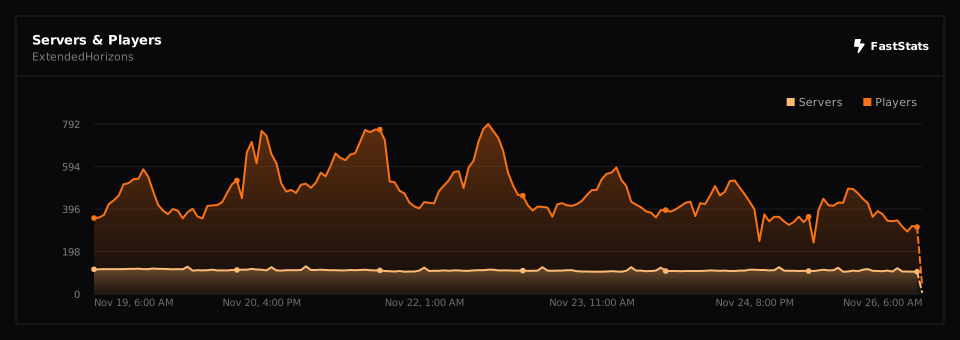
ExtendedHorizons collects anonymous metrics via FastStats (integrated through MapacheeeLib).
You can view global stats at the FastStats Dashboard.
- Bug Reports & Feature Requests: Open an issue on our GitHub Issues. Please attach your server version, plugin list, and relevant logs.
- Discord Community: Join our community for help and discussion at discord.gg/yA3vD2S8Zj.
- Donate: If you find this project valuable, consider supporting development on PayPal.